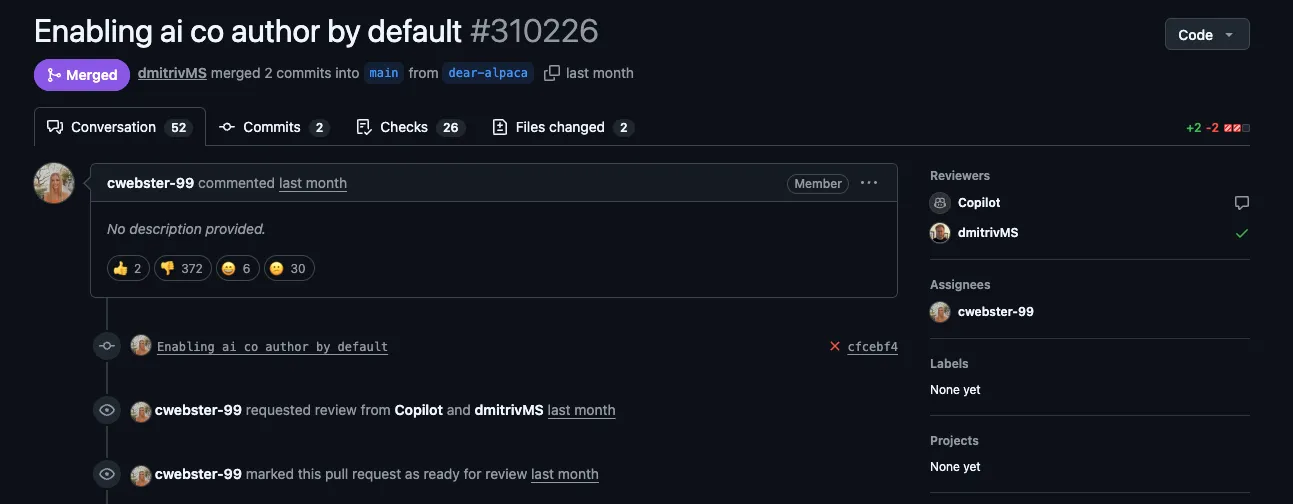
In April 2026, a small default in VS Code’s Git extension became a very large
conversation. Pull request #310226
changed git.addAICoAuthor from off to all: when the editor thought
AI had touched your work, it could add a Co-authored-by: Copilot trailer to
your commit message without you having turned that behavior on yourself.
That sounds like a niche setting. It is not niche when it touches the line of
attribution every reviewer, lawyer, and future you reads in git log.
What actually shipped
Co-authored-by lines are not decorative. They are part of how teams record
who shaped a change. Flipping the default meant more people would emit that
metadata automatically, on the assumption that the editor’s detection matched
reality.
The change lived in the Git extension’s contributed configuration: the schema
default moved to "all". The intent, as summarized in the thread, was to make
AI attribution the path of least resistance.
Why people were furious
The thread is long and sometimes ugly, but a few themes repeat with clarity.
Consent and surprise. A default that alters commit messages is a default that alters published artifacts. Many commenters said they only noticed after the fact sometimes on commits they believed were entirely hand written.
False positives. Several reports said Copilot trailers appeared even when
they were not using Copilot for that change, or believed they had opted out.
Notably, some people with chat.disableAIFeatures enabled still saw the
trailer exactly the kind of mismatch that reads as “the editor overrode my
intent.”
Signal vs noise. If Co-authored-by stops meaning “someone actually
co-authored this,” it stops helping governance, archaeology, or trust. One
commenter put it sharply: conflating “I used this editor” with “I co-authored
this” dilutes the signal the trailer was meant to carry.
There was also an ironic beat: a Copilot powered review on the PR flagged that
the runtime fallback in repository.ts still used 'off' while the schema
default said "all" a real consistency bug, and a memorable image of automation
commenting on automation.
What maintainers said afterward
After the pile-on, maintainer dmitrivMS acknowledged in the
PR discussion that the
rollout had problems: the feature should not run when AI is
disabled, it should not attribute non-AI work, and the default change needed
more test coverage. Follow-up work appeared in linked PRs and an issue with
more analysis (for example
#313725,
#313931, and
#314311). Maintainers
later limited who could post; by then, for many readers, the damage was as much
about trust as about bytes.
I am not here to litigate Microsoft’s motives. I care about the class of failure: a high-impact default, shipped quietly, that collided with people’s mental model of what a text editor is allowed to do to their commits.
The bridge to “agentic coding” and cognitive debt
Lars Faye’s essay “Agentic Coding is a Trap” is not about Git trailers. It is about what happens when we optimize for speed and delegation at the expense of understanding and how fragile that leaves us. One idea he surfaces citing Anthropic’s own research on the risks is almost a paradox: getting value from AI coding tools takes supervision, and supervision takes the skills that can atrophy if we always let the machine carry the load.
The VS Code incident is a small, concrete instance of the same pattern at the product default layer. When the tool silently signs your name next to another author, it widens the gap between what you think you shipped and what the record says you shipped. That is not “brain fog” in a clinical sense; it is cognitive debt in a systems sense. You pay interest every time you have to reconcile reality with metadata, or re audit commits you thought you understood.
Faye also argues that good engineering used to rank understanding above raw turnaround time, and that some AI-heavy workflows invert that list by default. A commit trailer is tiny, but the inversion is the same shape: speed of attribution first, fidelity of attribution second.
I do not think one bad default proves society is doomed to skill rot. I do think
it is a useful reminder: the UI will keep choosing for you unless you
re assert your own defaults both in settings.json and in how you work.
Alternatives to VS Code
Leaving VS Code is not required to stay in control; plenty of people will stay and tighten settings. If you do want an editor whose product posture feels closer to “AI when I ask for it,” not “AI in the plumbing,” two directions are worth a serious look.
Zed is the obvious modern counterexample. It is fast, native, and built around collaboration and a small surface area. AI exists in Zed, but it reads as an opt-in layer you wire up (providers, plans, explicit invocation) rather than a background assumption that every workflow is Copilot shaped. There is no Git extension from Microsoft quietly reinterpreting your commits; the mental model is closer to a sharp editor that can call models when you choose to. Tradeoffs: smaller extension universe than VS Code, and you are betting on a younger product but if your complaint is silent defaults and ambient AI, Zed is deliberately pointed the other way.
Helix is the other pole: a modal, terminal-first
editor in the Vim family with no built in AI at all. There is nothing to
“default on” for co-authorship or inline completion from a vendor stack; what you
get is treesitter-aware editing, sane out-of-the-box bindings, and an extension
story that is still minimal compared to VS Code which, for this essay, is a
feature: fewer moving parts that can ship a surprise under settings.json
defaults you never read. If Helix is too bare for your day job, the same ethic
holds for Neovim or plain Vim with a hand-picked config: no AI until you
add a plugin and mean it.
Neither is a moral victory over VS Code. Both are reminders that defaults are a design choice and some teams choose visibility and explicitness first, then layer intelligence on top when you ask.
How I am treating this in my own workflow
I still use AI in editors, but I reach for it when the task calls for it not as the default way I write code. When I do use it, I supervise the work closely: I read diffs, question suggestions, and own the result before it ever becomes a commit. That lines up with how I want attribution to read: if a model genuinely helped on a change, I am fine saying so; if I was the one steering every line, I do not want a trailer implying otherwise.
I treat commit metadata as part of the product surface. After this episode I re checked Git-related settings in any VS Code based environment I use and kept attribution opt-in in spirit even when the product wants convenience.
If there’s one truth that matters after all of this, let it be this: The only worthwhile AI workflow is the one where you have clarity about every commit what you shipped, and why. Never let a tool blur the record of your work, to yourself or to history.
Further reading
- VS Code PR #310226 — Enabling AI co-author by default
- Lars Faye — Agentic Coding is a Trap
- VS Code issue #314311 (post-incident write-up linked from the thread)
- VS Code PR #313725 (community proposal to default
git.addAICoAuthortooffagain)